

Category — Technique · Read time : 6 min Published — November 4, 2024 By — Thomas Renard
Introduction
Everyone talks about color grading like it is some kind of dark art reserved for Hollywood post-production houses with six-figure budgets. It is not. But it does require the right foundation — and knowing what that foundation looks like before you invest time and money is the difference between building a real skill and spinning your wheels for months. Here is what you actually need.
01 — The Right Software
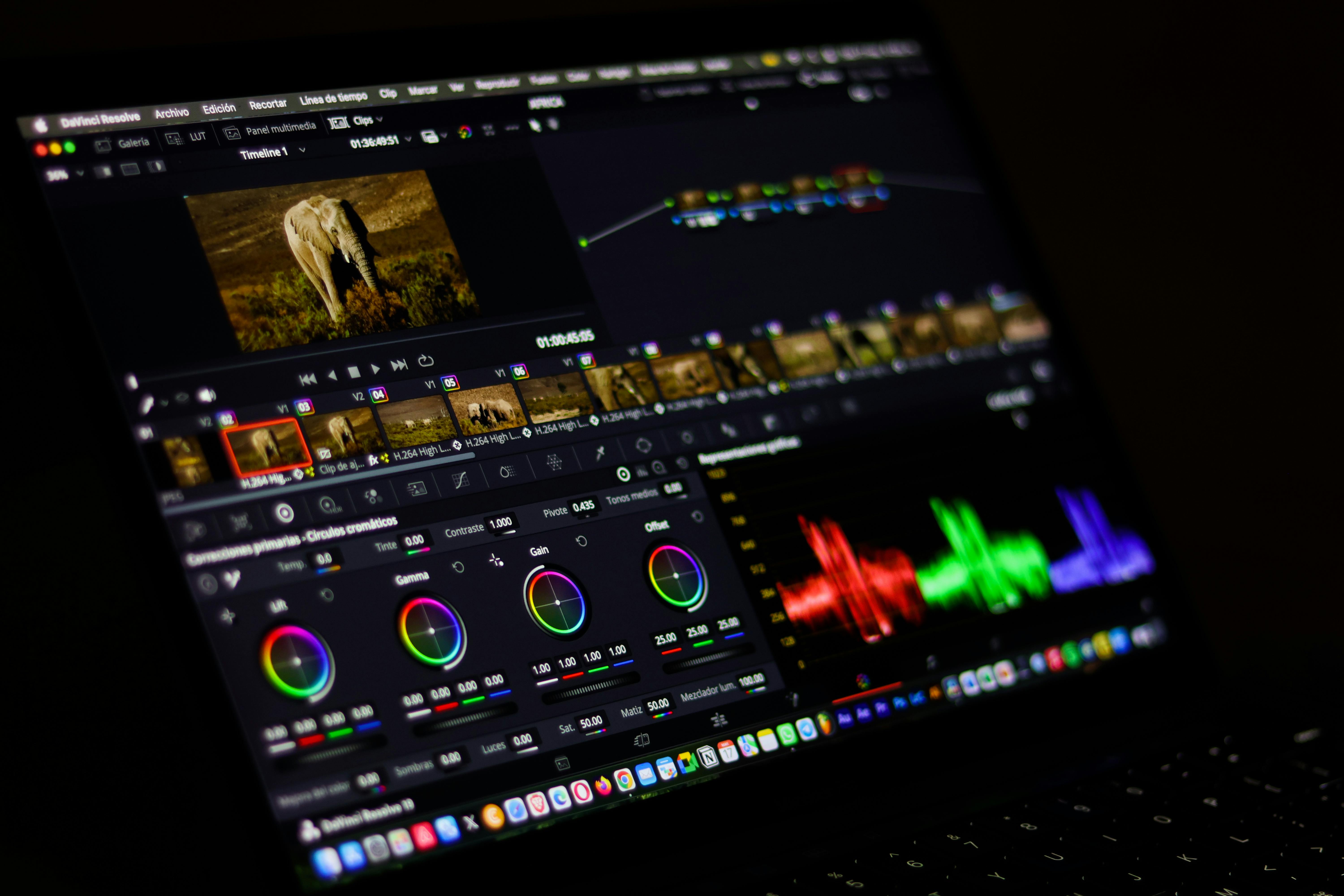
The industry standard is DaVinci Resolve. The free version is genuinely powerful enough to do professional work — most colorists working on commercial projects use it daily. It has a dedicated color page built specifically for grading, a node-based workflow that gives you complete control, and a learning curve that rewards patience.
Premiere Pro and Final Cut Pro both have color tools built in and they are perfectly usable for event videography and corporate content. But if you are serious about color grading as a craft, Resolve is where you want to be. Start there and learn it properly.
02 — A Calibrated Monitor
This is the one investment people skip and then wonder why their grades look different on every screen. If your monitor is not calibrated, you are not grading — you are guessing. You do not need a reference monitor that costs thousands. You need a decent IPS or OLED display and a calibration tool like the X-Rite i1Display to set it correctly.
Color temperature, brightness, and gamma all need to be set to a standard baseline before you touch a single clip. Without this, nothing you do in the grade is reliable.
03 — Properly Exposed Footage
Color grading cannot fix a badly exposed shot. It can rescue one. There is a difference. The best material to grade is footage shot in a flat or log profile — S-Log, V-Log, C-Log depending on your camera — because it retains the maximum amount of information in the highlights and shadows. That information is what gives you room to work in post.
If your footage is already crushed in the blacks or blown out in the sky, the grade will only go so far. Good color grading starts on set, not in the edit suite.
04 — An Understanding of Color Theory
You do not need a degree in fine arts but you do need to understand the basics. Complementary colors, color temperature, how hues interact with skin tones, what a lift-gamma-gain correction actually does. These are not optional — they are the vocabulary of the craft.
The fastest way to build this foundation is to study films and commercials you admire and ask yourself why they look the way they do. Is it warm or cool ? High contrast or flat ? Are the shadows clean or do they shift into a color ? Then try to recreate it. That exercise alone will teach you more than any tutorial.
05 — A Consistent Workflow
Professional color grading is not just about making images look beautiful. It is about making an entire project look consistent — so that a shot from 9am and a shot from 4pm feel like they belong in the same film. That requires a structured workflow : primary corrections first, then secondaries, then creative grade, then export.
Every colorist develops their own system over time. The important thing early on is to have one at all — to approach every project the same way so that your process becomes muscle memory and your brain is free to focus on the creative decisions.
06 — Patience
Color grading is a slow skill to build. The first few months you will grade something, feel proud of it, look at it two days later and see everything that is wrong. That is not failure — that is your eye developing faster than your hands. Keep going.
The colorists whose work you admire have graded hundreds of projects. There is no shortcut to that experience. But every project you finish, however imperfect, puts you closer to the work you are trying to make.
To Summarise
You need DaVinci Resolve, a calibrated monitor, properly exposed log footage, a working knowledge of color theory, a consistent workflow, and time. That is it. None of it is out of reach. The barrier to professional color grading is not equipment or budget — it is the willingness to learn slowly and do the work seriously.